
There is a lot of stuff cooking in T-rank these days. We are building out new ways for financial analysts, developers, and AI-powered tools to interact with our ownership data platform — and today we want to lift the lid on one of them: T-rank now speaks MCP.
What is MCP?
MCP is an open standard that lets AI assistants (like Claude, Google Antigravity, or your own custom agent) connect to external data sources and services in a structured, secure, and reusable way. Instead of writing integration code for every tool, MCP defines a shared “language” that an assistant can use to discover and navigate your data.
In practical terms: any MCP-compatible assistant can start querying ownership networks, resolving beneficial owners, and exploring corporate role structures — without a single line of bespoke glue code.
On a more technical note; MCP works as a client-server protocol. A host (your assistant or agent runtime) connects to one or more MCP servers, each of which exposes a catalogue of named tools. Each tool has a well-defined JSON Schema describing its parameters. The host can introspect the catalogue at runtime, pick the right tool for the task, call it with structured arguments, and get back structured results — all within the same conversational loop. Authentication and error handling are all negotiated through the MCP layer, so the agent can stay focused on reasoning rather than plumbing.
Implications for Obliged Entities
Obliged entities spend a lot of effort on analysis; not because it is intellectually hard, but because it is operationally tedious. Hunting down beneficial owners across layered structures, merging data from multiple sources, and documenting the chain of reasoning all consume the analysts’ time.
MCP can potentially change this in several ways:
- Conversational KYC workflows: Analysts can conduct ownership investigations the same way they would talk to a knowledgeable colleague — as demonstrated below — where no context switching between systems is needed.
- Regulatory reporting assistance: The
beneficial_ownerstool supports the full range of BO models recognised across Nordic jurisdictions, including direct access to national BO registers for obliged entities. The assistant both understand and speak the regulatory language, and the assistant can then make sure the output complies with AMLR. - Developer acceleration: Teams can prototype ownership-aware features by pointing their MCP host at T-rank. The tool catalogue self-documents, so onboarding the developers is fast.
- Continuous monitoring: An agent can watch for changes in a watchlist of entities. When ownership structure, beneficial owners, or risk indicators change, the agent tells. Scheduled agents can also automatically re-run beneficial owner checks across a customer portfolio, flag changes, and summarize updates for review in a compliance workflow.
Example — “Who really owns this company?”
A compliance officer is onboarding a new corporate client: Green-Sipes. They type into their AI assistant:
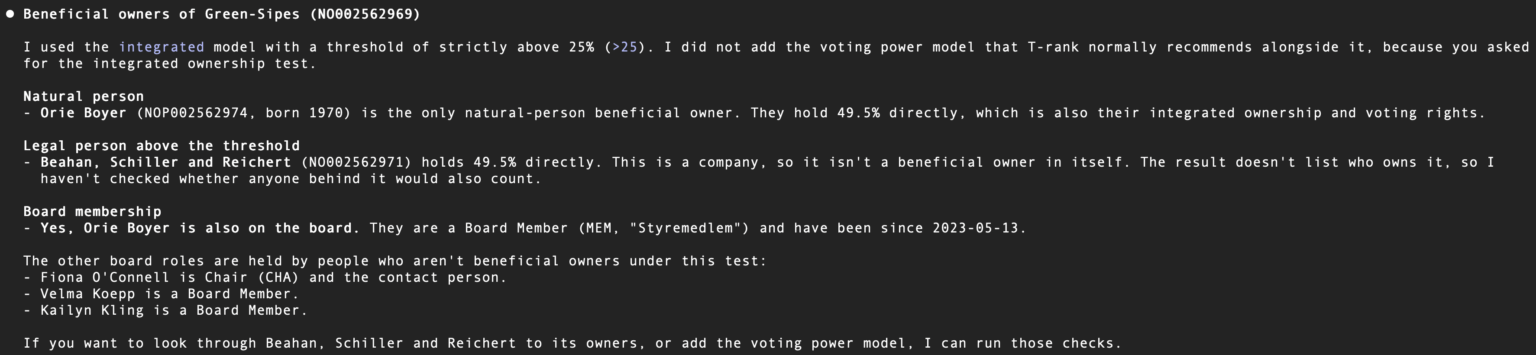
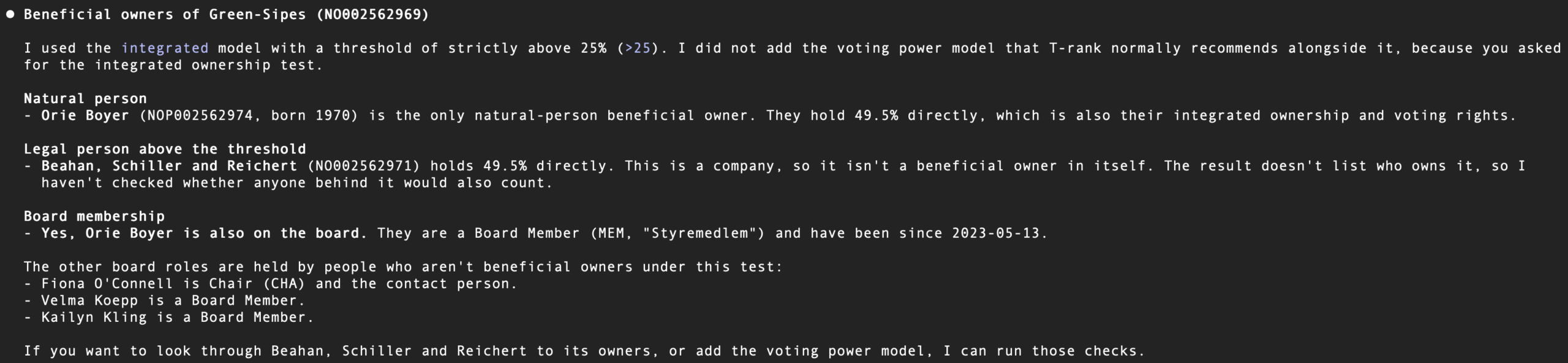
Who are the beneficial owners of Green-Sipes under the standard 25% integrated ownership threshold, and are any of them also board members?
Without MCP, this means at least the following manual steps: (1) look up the org number, (2) call the beneficial_owners endpoint, (3) separately call company_roles, (4) cross-reference the results, and (5) write a summary. However, with the MCP service, the output can look like this:
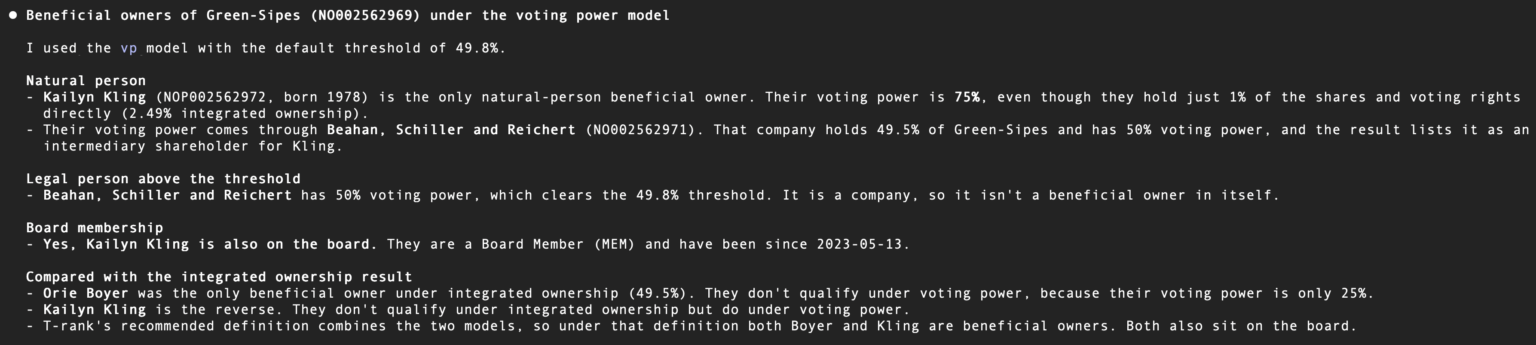
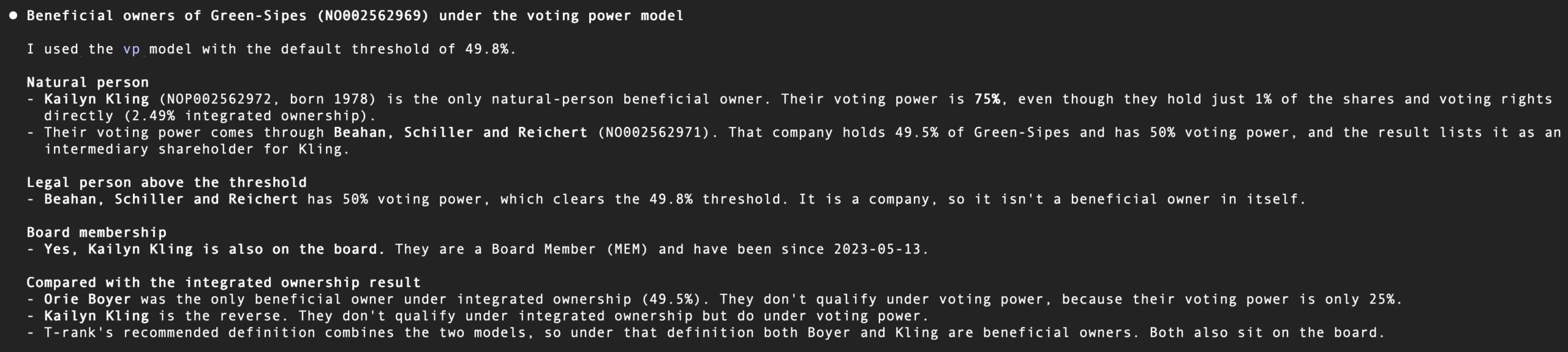
Seeking more insight into beneficial owners, we switch model:
Who are beneficial owners of Green-Sipes using the voting power model?
Show the shareholder map of Green-Sipes
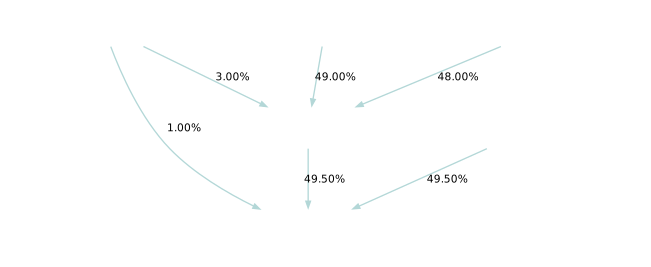
The compliance officer gets clean answers in seconds, with no API calls written by hand.
T-rank’s MCP server tools
T-rank’s MCP server currently exposes the following tools:
| Tool description | |
search_entities | Free-text search to find entities (primarily by name) and retrieve their IDs |
beneficial_owners | Retrieves beneficial owners for a company based on one or more specified models (e.g., integrated ownership, voting power, register comparison) |
owners | Find direct and indirect owners of a legal entity given specified ownership or voting thresholds |
holdings | Find what an entity directly or indirectly owns (can also include real estate) above given thresholds |
ownership_indicators | Returns indicators relevant for risk assessment and compliance tasks |
company_roles | Returns contact persons and roles (board members, CEO, auditor, etc.) for a specified company |
roles_of_entity | Find all companies/entities where a given entity or person holds a registered role |
shareholder_map | Generate an SVG or PDF ownership structure map showing owners, holdings, or corporate group |
Are you already a customer of T-rank through one of our data collaborators? If you want to explore what MCP-powered ownership analysis can look like in your workflows, we want to hear from you.
More News & Thoughts
- – The Danish Beneficial Ownership Register – T-rank.no (2026.09.18)
- – GROW: Group Ownership – T-rank.no (2026.08.20)
Written by Kenth Engø-Monsen – kenth (at) trank (dot) no