
At T-rank, we are continuously exploring new ways to better understand complex ownership structures. Some questions are apparently easy to ask, but then, when you start looking into the gory details things can change character. One such question is: What is the accumulated ownership for a group of entities?
Given a shareholder network, we want to calculate the accumulated, integrated ownership for a subgroup of shareholder entities in the ownership structure. If your first impulse is to sum all the individual, integrated ownerships for each member entity in the group, that will not lead to the right numbers.
Let’s look at an example.
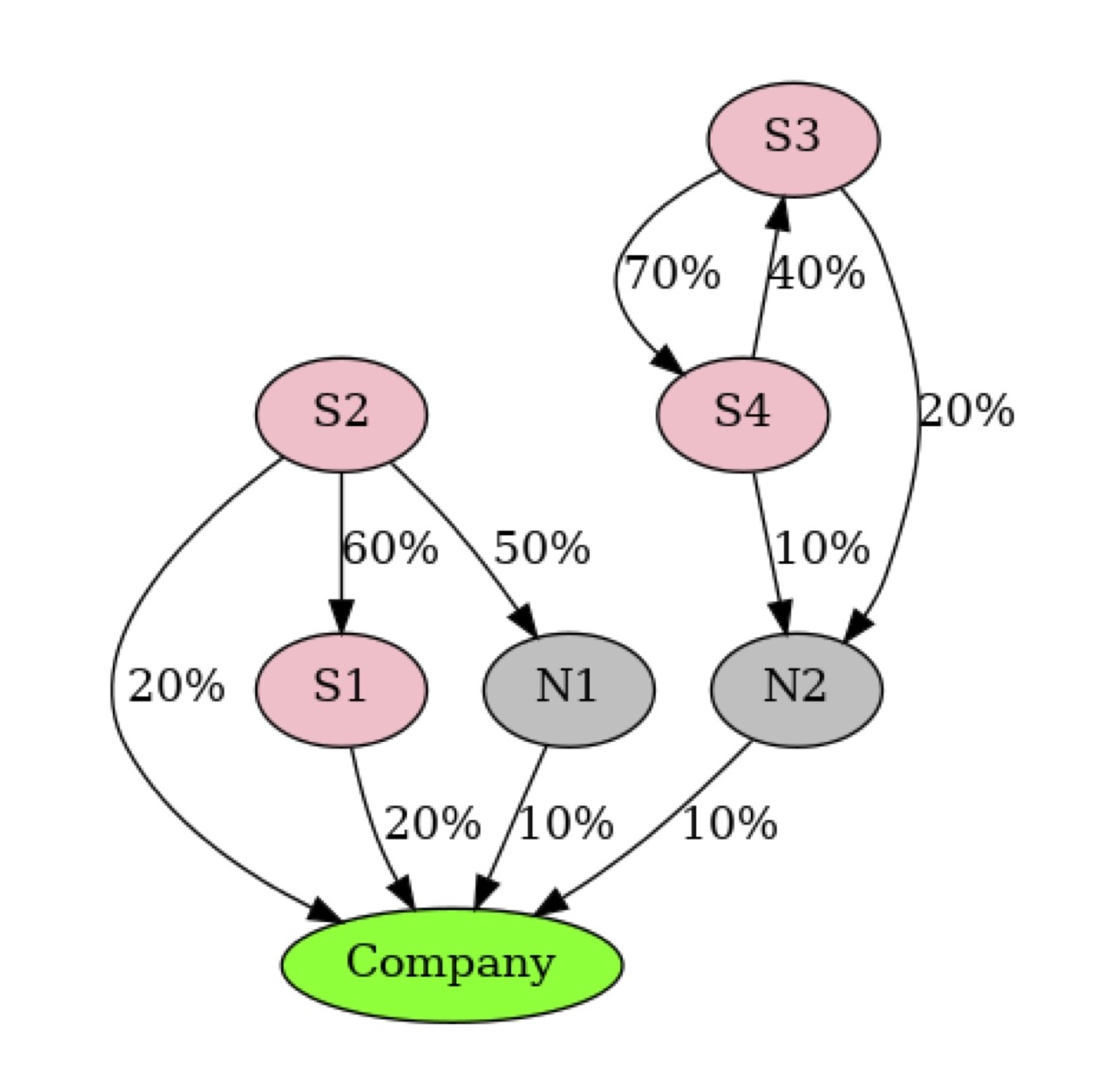
Let us first consider the subgroup that consists of the entities S1 and S2 and their ownership in Company. The individual, integrated ownerships are the following: S1 owns 20% in Company, and S2 owns 20% + 20%*60% + 10%*50% = 37% in Company. The joint group integrated ownership of S1 and S2 in Company is not 20% + 37% = 57%. Due to double counting, this estimate is too large. Hence, the correct accumulated ownership of the group (S1, S2) in Company is 45%.
Next, we expand the group to include (S1,S2,S3,S4). Then the accumulated, integrated ownership comes in at 48%, that is much less compared to the inflated estimate 61,5% when summing the individual, integrated ownership scores.
In a small example, the impact of double counting is clearly and easily demonstrated. However, when the ownership network grows into 100s or 1000s of nodes, the situation becomes something very different, and maintaining a clear overview becomes increasingly challenging.
T-rank’s GROW methodology
T-rank has developed Group Ownership (GROW)—a methodology featuring two algorithms designed to calculate aggregated integrated ownership efficiently: Global and Local GROW.
Global GROW is designed for extensive datasets, enabling the computation of accumulated ownership across an unlimited number of entity groups in a single pass. It applies modified input parameters to standard integrated ownership algorithms. However, for Global GROW to yield precise results, it requires adherence to one of two strict conditions: either all groups must remain entirely disjoint with no intersecting ownership paths, or there must be no internal ownership paths within the groups themselves.
Local GROW is tailored to determine the collective, integrated stake held by a defined entity group within a single target firm. The algorithm runs in-memory by utilizing existing integrated ownership metrics between group members and the company, and accounting for internal group dependencies, it eliminates the need for full network exploration. This focused approach provides a swift, computationally elegant path to revealing the actual ownership landscape.
Applications
When can the GROW algorithms come in handy? Let’s look at some applications:
In the space of sanctions there are several applications of GROW: Assume that you want to assess the accumulated, integrated ownership percentage of a given company by a set of sanctioned companies. If the sanctioned companies as a group own the company in question above a certain threshold, the company is sanctioned by extension. Similarly, a company is sanctioned by the existence of natural persons residing in specific, sanctioned territories, that in total own more than the specified threshold. Then the company is geographically sanctioned.
Other, ideal applications of GROW are: Assessing to what extent a non-listed company is owned by other listed companies. Assessing how much a company is owned by states or public institutions is also straightforward to handle for GROW. And finally, GROW can be used to assess how much a company is owned by a specific corporate group–this to evaluate whether the company shall be considered a part of the corporate group or not. This is vital information in terms of understanding total loan exposure.
A bigger example
Let’s demonstrate how to apply GROW to determine the total accumulated, integrated ownership held in a given company by publicly listed companies. The total number of entities for the complete shareholder map based on all available data contains in this case several thousand entities. Hence, showing the full shareholder map is not useful, and assessing the group ownership of all the listed companies is not straight forward. Zooming in on the listed companies, and running the GROW algorithm, we are able to calculate that the accumulated, integrated ownership of all the listed companies in the company Bins LLC is 49.98%, compared to the inflated sum of the individual integrated ownerships of 61.45%.
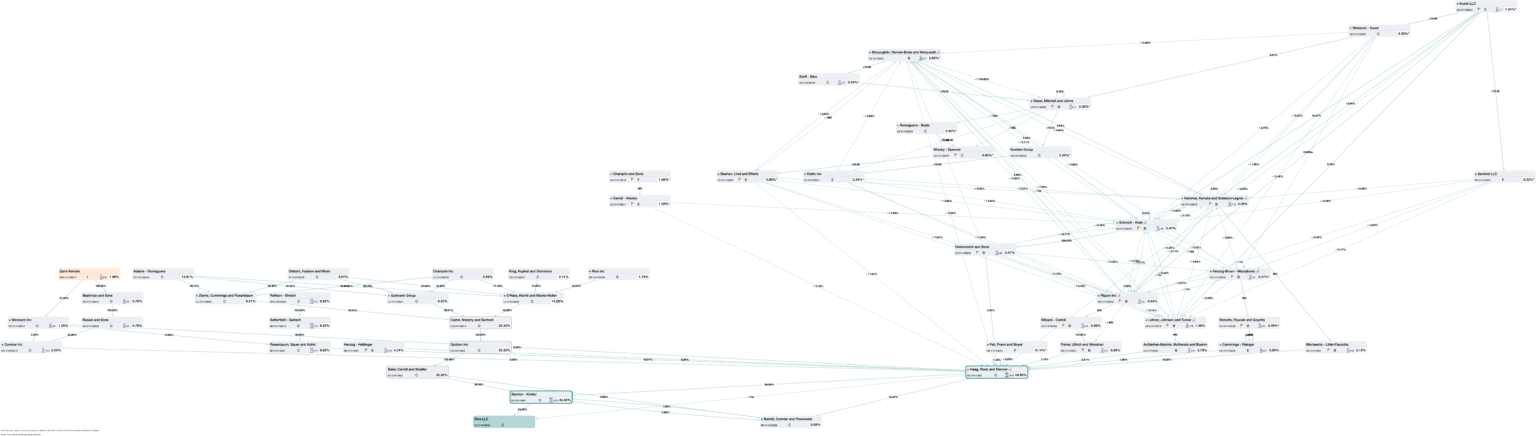
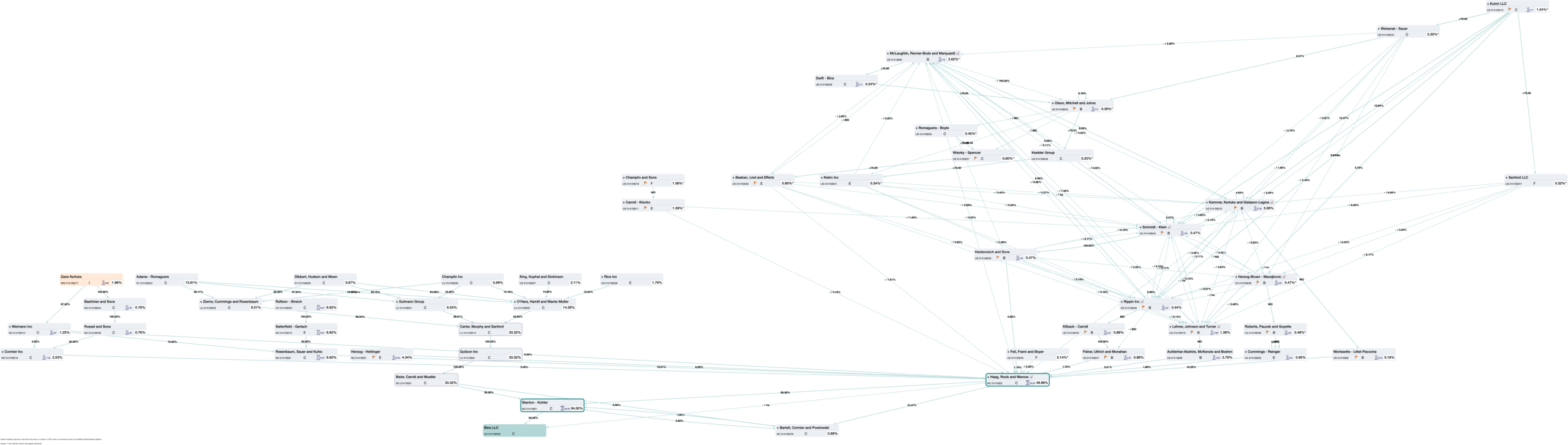
This is an anonymized example where we illustrate GROW applied to the case of assessing the accumulated, integrated ownership attributed to listed companies.
Summary
The complexity of calculating integrated ownership for subgroups of entities within a shareholder network should not be underestimated. Simply summing individual integrated ownership percentages leads to errors caused by double counting, necessitating a more advanced approach.
T-rank has developed the Group Ownership (GROW) methodology to solve this issue through two algorithms: Local and Global GROW. Reach out if you are interested in discussing the GROW methodology and any of the applications in more detail!
Written by Kenth Engø-Monsen – kenth (at) trank (dot) no