
T-rank has previously presented an analysis done together with Sparebanken Norge, on the accuracy of Norway’s beneficial ownership register (RRH-registeret). Comparing a corporate portfolio against external databases, we uncovered an 84% accuracy match between the register and independent sources and discrepancies emerged in the remaining 16% of companies: 7% had owners listed externally but missing from the register, 7% listed owners in the register who were absent from external data, and 2% showed deviations in both directions.
The 16% discrepancy rate is primarily driven by complex corporate structures and family relationships. The core takeaway from the analysis is clear: reporting entities cannot rely exclusively on a national register for compliance; they must apply risk-based assessments and consult independent data.
In this blog post, we shift our focus across the Skagerrak to look at the Danish beneficial ownership register (Register over Reelle Ejere). Do we see the same discrepancies in the Danish register? Making sure that we all have the same starting point, let’s review the Danish definition of ultimate beneficial owners (“Reelle Ejere”): You are a beneficial owner if at least one of the following two conditions are met:
- – Direct or indirect control over more than 25% of the voting rights.
- – Integrated capital ownership exceeding 25%.
The Danish shareholding registration framework is structurally unsuited to serve as a single source of truth for AML- and KYC-compliance. The main reason for this is the systemic use of interval reporting rather than absolute percentages in the determination of company ownership. The consequences of this choice, is that it creates modeling challenges and clutters the algorithmic approach.
The interval reporting of ownership directly impacts the estimation: Algorithms are forced to choose the lowest possible value of an interval to avoid mathematically exceeding 100% total ownership, potentially dropping true controllers off the compliance radar. Also, one cannot reliably distinguish whether a reported ownership in the interval [25 – 33 ⅓]% implies an exact, non-controlling 25% stake or a significant dominant interest.
Because of this difference in the reporting, we are not able to carry out the same kind of analysis on the Danish register of beneficial owners and directly compare it to other Scandinavian registers. But, we can still hunt for discrepancies in the Danish register. We look for differences in the registered beneficial owners and compare to the calculated beneficial owners proposed by integrated ownership and voting power.
Some Examples
All examples are anonymized, in order to obfuscate the true companies and individuals.


According to the Danish beneficial owners register, ‘Isabelle Jacobi’ is listed as the ultimate beneficial owner of ‘MacGyver – Goldner’. However, this registration warrants a challenge: omitting ‘Dr. Wilmer Parker’—who holds 100% aggregated ownership—appears inconsistent with the Danish definition of a beneficial owner. While informal agreements can influence BO determinations, this configuration clearly requires further investigation.
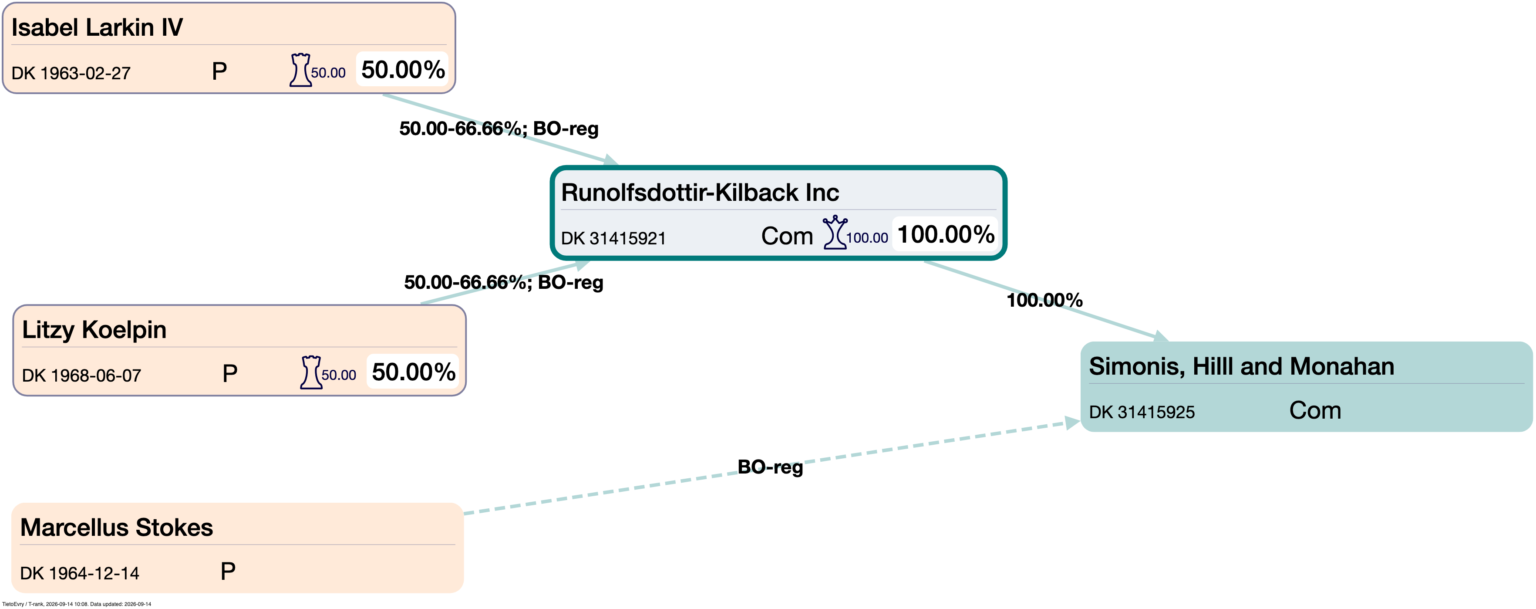
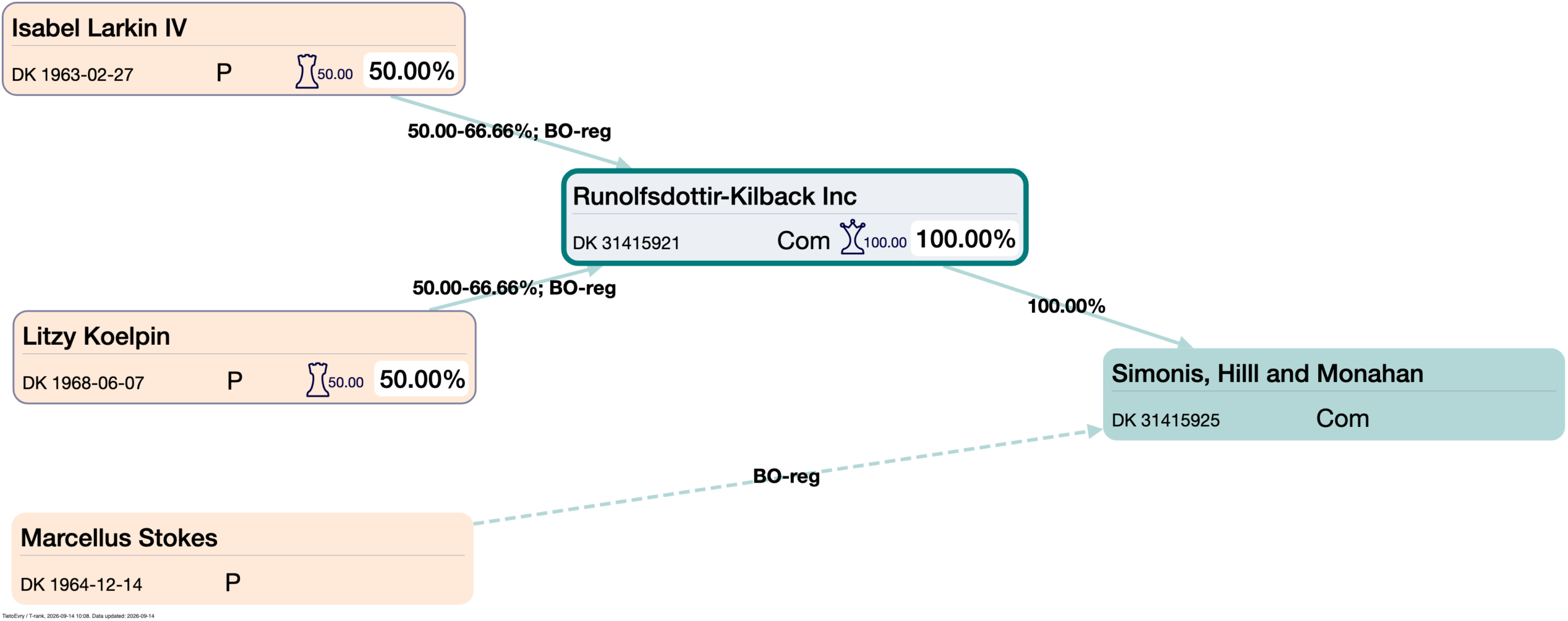
This is another example where there are inconsistencies in the registration of ultimate beneficial owners. For the company ‘Simonis, Hilll and Monahan’, the two obvious candidates according to the Danish beneficial owners definitions are missing, and it is not clear as to why the person listed as beneficial owner is indeed registered as a beneficial owner.
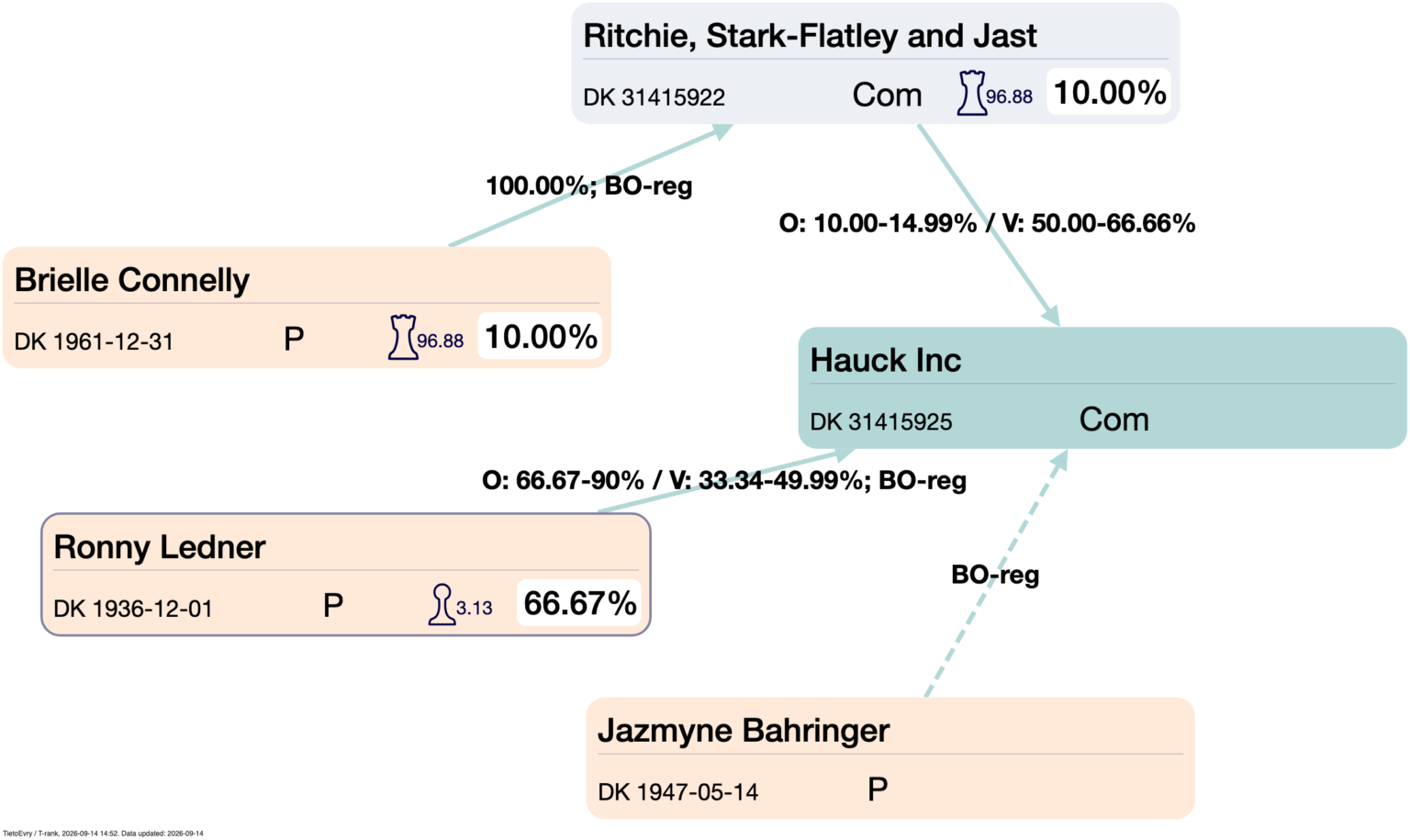
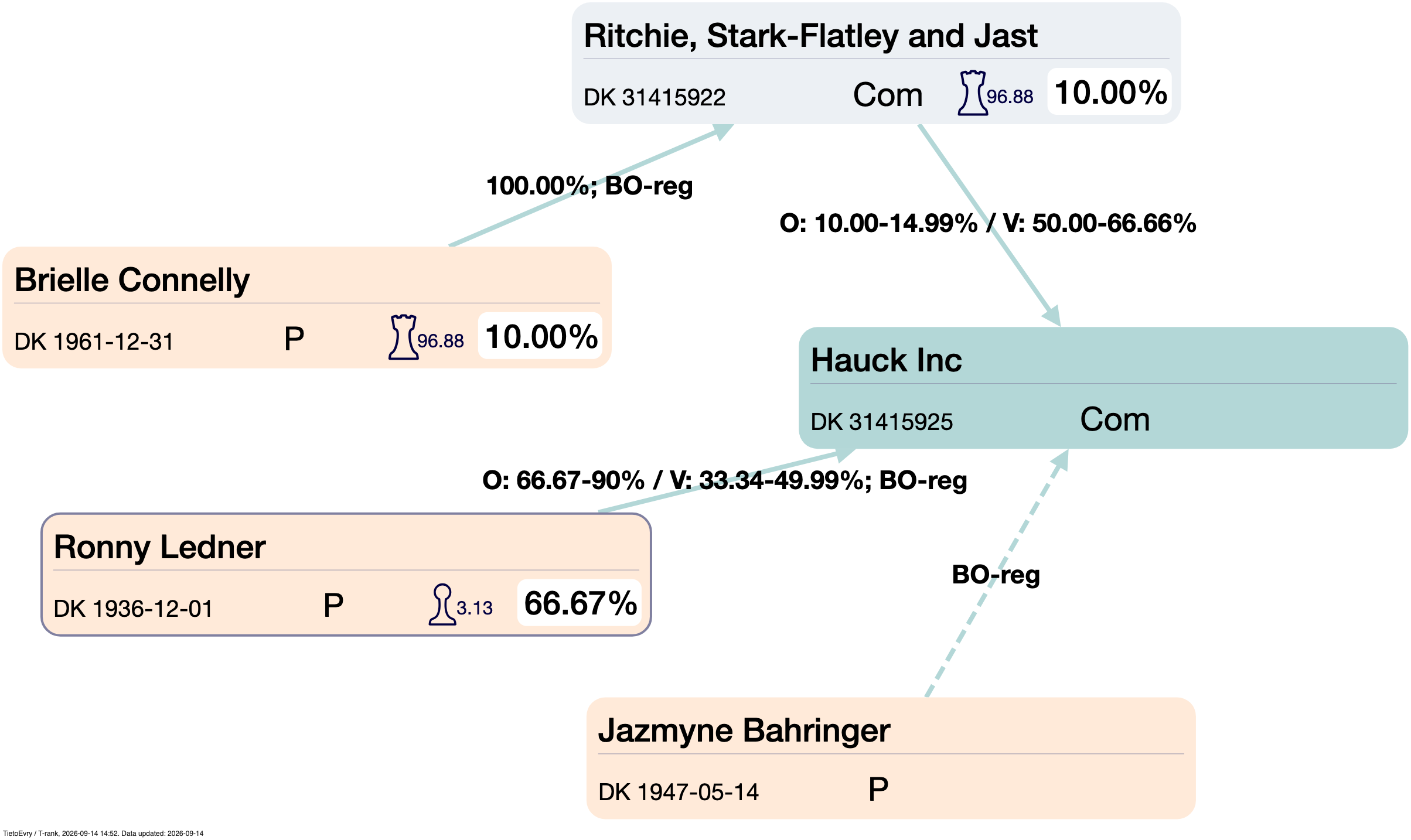
Data from the Danish beneficial ownership register lists ‘Jazmyne Bahringer’ and ‘Ronny Ledner’ as the ultimate beneficial owners of ‘Hauck Inc’. While ‘Ronny Ledner’ meets the threshold of holding over 25% total integrated ownership, the inclusion of ‘Jazmyne Bahringer’ introduces potential inconsistencies. Furthermore, analyzing voting rights reveals that ‘Brielle Connelly’ controls sufficient voting power to warrant listing as a beneficial owner as well. Consequently, additional scrutiny is necessary to ascertain the accurate beneficial ownership structure for this entity.
In the above three examples, the true reasons for the discrepancies in the registration of beneficial owners are outdated previous owner information, a wrongly listed CEO as beneficial owner, and most likely paperwork delays following an owner’s passing, respectively.
Takeaways
- Systemic Challenges of Interval Reporting: The Danish register’s reliance on ownership intervals rather than exact percentages introduces severe modeling ambiguities and blinds compliance algorithms to true corporate controllers. To enhance the precision of AML/KYC compliance work, this reporting structure needs to be remedied with exact declarations.
- National Registers Are Not a Safe Harbor: Despite the structural noise from interval reporting, significant discrepancies and missing beneficial owners are clearly identifiable in the Danish register. Consequently, the core finding from the Norwegian comparison holds true for Denmark: reporting entities cannot rely exclusively on a national register for compliance; they must apply risk-based assessments and consult independent data sources.
Additional reading
- – RRH-registeret under lupen! – T-rank.no (2025.12.12)
- – Potential errors in the Norwegian Register of Beneficial Owner – T-rank.no (2025.08.26)
Written by Kenth Engø-Monsen – kenth (at) trank (dot) no